
Access all our platforms from a single account.

Asia Market Quick Take – 28 October, 2026

Key points:
- Macro: Australia CPI accelerates to 4.3%. US durable goods orders rise 1.8%.
- Equities: SOX index gained 3.6% while Boeing falls 10.7% as tech outperforms
- FX: RBNZ holds OCR at 2.75%; NZDUSD breaks below 0.56
- Commodities: WTI falls below $100 while gold rebounded off $4,000
- Fixed income: US Treasury curve twist flattens with 10 year near 5%
------------------------------------------------------------------
Disclaimer: Past performance does not indicate future performance.
Macro:
- Israeli exit polls showed opposition leader Gadi Eisenkot narrowly ahead of Prime Minister Netanyahu, with no clear majority and weaker support for Netanyahu. Markets also weighed new diplomacy after Saudi, Pakistani, and Turkish officials met Iranian leaders, as Iran’s Supreme Leader Mojtaba Khamenei urged an end to the “neither war nor peace” status quo.
- Australia Q3 trimmed mean CPI rises 3.7% y/y vs 3.6% est; +1.0% q/q in line. Hotter core inflation bolsters RBA hike case.
- US new single-family home sales fell 0.6% in September 2026 to 676,000 annualized, just below August’s 680,000 but above the 650,000 forecast, as high mortgage rates and inflation hit affordability. Sales dropped in the South and Midwest but rose in the West and Northeast. Inventory fell to 476,000 homes (8.4 months), and the median price rose to a three-month high of $400,400.
- US durable goods orders rose 1.8% m/m in September 2026, above the 1.5% forecast, driven by a 4.6% jump in transportation, including a 28.4% surge in civilian aircraft. Ex-transportation, orders increased 0.5%; ex-defense, 2.2%. Core capital goods (non-defense ex-aircraft) were up 0.5%.
- US new single-family home sales slipped 0.6% in September 2026 to 676,000 annualized, just below August’s 680,000 but above the 650,000 forecast. Sales fell in the South and Midwest, rose in the West and Northeast, inventory declined to 476,000 homes (8.4 months), and the median price reached a three-month high of $400,400.
- The S&P CoreLogic Case-Shiller 20-City Index rose 2.7% y/y in August 2026, the fastest since May 2025 and above the 2.5% forecast. Chicago, New York, and Cleveland led gains, while Seattle, Las Vegas, and Denver declined. Prices fell 0.4% m/m but rose 0.3% in real terms, with affordability still pressured by high costs and mortgage rates in the mid-to-high 6% range.
Equities:
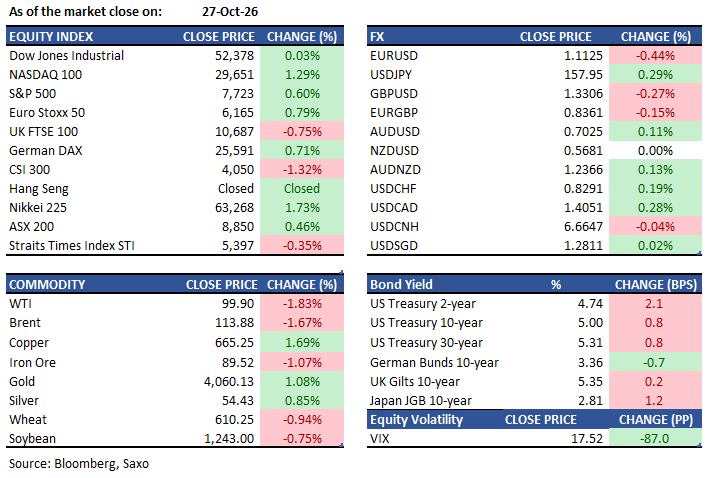
- US: US equities rallied on Tuesday, led by technology and AI-related names. S&P 500 rose 0.60% to 7,722.60, the Nasdaq Composite gained 1.18% to 26,477.81, and the Russell 2000 advanced 1.16% to 2,818.87. The Dow was essentially flat, adding just 0.03% to 52,377.57. The SOX semiconductor index surged 3.6%, its best day in over a month. Key movers included SoFi Technologies (+13.4%), Credo Technology (+10.8%), Astera Labs (+10.5%), and Cerebras Systems (+10.1%). Boeing shares saw their worst one-day drop of 10.69% in six years, while Coca cola down 1.6% after beating earnings estimates and raising full year outlook. In after-hours, NXP Semiconductors tumbled 7.5% after issuing weaker-than-expected revenue guidance, while Logitech fell 7.0% after flagging a $70–80 million Q3 sales headwind from a semiconductor supplier facility shutdown.
- EU: European equities were broadly higher, with the AI and tech rally providing a tailwind. The DAX rose 0.71% to 25,590.77, the Euro Stoxx 50 gained 0.79% to 6,164.69, and the CAC 40 added 0.51% to 7,887.14. The FTSE 100 was the outlier, falling 0.75% to 10,686.54, weighed by Reckitt Benckiser, which dropped as much as 7.9% after cutting its full-year sales forecast following a Lysol manufacturing disruption. Mercedes-Benz cut its profit guidance, joining BMW and Volkswagen in citing a deteriorating China market. Ferretti slid as much as 9.6% after cutting profitability guidance. Alfa Laval edged higher after a significant beat on orders driven by data centre and semiconductor demand.
- Asia: Asian equities advanced broadly, tracking Wall Street's AI-driven rally and buoyed by SK Hynix's blowout earnings. The KOSPI surged 3.20% to 5,827.24, with SK Hynix rising as much as 3.7% and Samsung Electronics up as much as 4.3% in sympathy. Naver rose 5.0% on heavy volume. The Nikkei 225 gained 1.25% to 64,065.33, though Asahi Group fell 3.3% and Otsuka Corp declined 4.1%. The Hang Seng was flat at 23,041.32, with Suzhou Dongshan Precision's HK debut falling as much as 12% in grey market trading after pricing at a 35% discount to its Shenzhen-listed shares. The STI closed at 5,397.03, with no significant change on the day. The MSCI Asia Pacific Index rose 0.6%
Earnings this week:
- Wednesday: Alphabet, Microsoft, Ford, Ping An Insurance, PetroChina, Hitachi, SK Hynix
- Thursday: Merck, Mastercard, Caterpillar, Intel, Amazon, BYD, Denso, Keyence, Wilmar International
- Friday: Chevron, ExxonMobil, China Construction Bank, Kweichow Moutai, CNOOC, ICBC, Bank of China, Sands China, Panasonic
FX:
- EURUSD fell 0.44% to around 1.1137, the largest G10 decline on the day, as the dollar strengthened ahead of the Fed decision. Concerns over France's reliance on foreign investors in its debt market added to euro headwinds.
- USDJPY rose 0.29% to near 157.97, approaching the 158 level, as lower oil prices and gains in US equities prompted dollar buying. Traders remain cautious ahead of both the FOMC and Bank of Japan policy meetings.
- GBPUSD slipped 0.27% as sterling faced headwinds ahead of the UK budget announcement. Options markets implied a breakeven of around 65 pips, with the October 22 high at 1.3419 seen as outside the implied move.
- RBNZ holds the OCR at 2.75% in a surprise 4–3 vote, citing global uncertainty and defying most forecasts (only 2/25 expected a hold); NZD fell as much as 1.7% to 55.86 US cents; no new projections, governor to speak at 3 p.m. local.
- Philippine peso hit a record low of 64 per dollar, making it Asia's worst-performing currency this year, as elevated crude oil prices weighed on the net energy importer. Thai baht traded near an 18-month trough, while the Korean won outperformed on the back of strong GDP data and the KOSPI rally.
Commodities:
- WTI crude fell 1.83% to $99.90/bbl and Brent declined 1.67% to $113.88/bbl on Tuesday, as diplomatic signals around a potential Iran ceasefire eased geopolitical risk premiums. Reports that the Trump administration may allow more Russian diesel exports onto global markets also weighed on sentiment.
- Gold rebounded 1.08% to $4,060.13/oz after briefly dipping below the $4,000 level in prior sessions, as bargain hunters returned ahead of the Fed decision. Lower Treasury yields and easing oil prices provided additional support.
- LME 3-month copper rose 1.03% to $14,474.50/mt, supported by AI infrastructure demand optimism, though analysts note the metal's traditional role as a macro barometer is increasingly complicated by its sensitivity to AI trade dynamics and elevated interest rates.
Fixed income:
- Treasuries ended mixed. The 2-year yield rose 1.7bps to 4.739%, the 10-year edged up 1.0bp to 5.001%, and the 30-year gained 0.8bps to 5.314%. The curve twist-flattened around the 10-year, with the front-end and belly underperforming. The 5s30s spread narrowed to approximately 46bps from 48bps. Activity was muted ahead of Wednesday's Fed meeting.
- The Treasury sold $70 billion in 5-year notes at a high yield of 4.845%, tailing the when-issued yield by 0.4bps — the tenor's 12th consecutive weak result, though demand improved meaningfully from last month's 5.033% stop.
- Analysts warn that bullish Treasury positioning is vulnerable to a sharp reversal if Fed Chair Warsh delivers hawkish messaging on inflation at Wednesday's meeting. Bond investors are also growing sceptical that potential post-midterm gridlock will ease US fiscal deficit concerns, as it has historically.
For a global look at markets – go to Inspiration.
This content is marketing content and should not be considered investment advice. Trading financial instruments carries risks and historic performance is not a guarantee for future performance.
The instrument(s) mentioned in this content may be issued by a partner, from which Saxo receives promotion, payment or retrocessions. While Saxo receives compensation from these partnerships, all content is conducted with the intention of providing clients with valuable options and information.